
Keywords
ritual kitchen
epistemic space
olah rasa
Osing people
How to Cite
Abstract
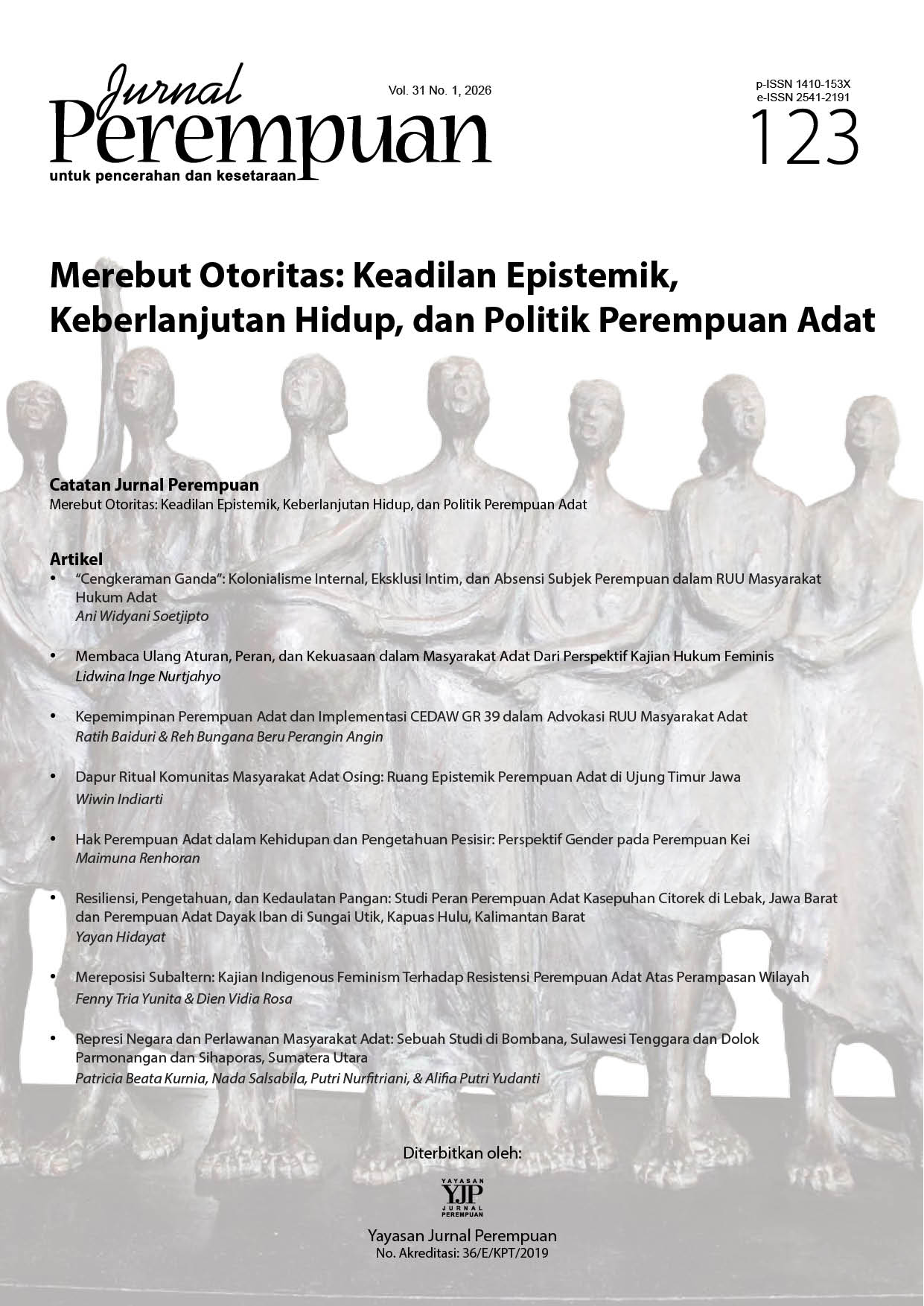
This article examines the ritual kitchen of Osing people in Banyuwangi as an epistemic space of Indigenous women rather than merely a domestic sphere. Drawing on an ethnographic approach and a critical reading of olah rasa practices, the study positions Indigenous women as knowing subjects who actively produce, preserve, and transmit cultural, ecological, and spiritual values. The ritual kitchen is understood as a site of knowledge production that is embodied, relational, and contextual, where knowledge is transmitted through practice, bodily discipline, and adherence to ancestral mandates. Ritual culinary practices analysis reveals that Osing Indigenous women’s knowledge plays a vital role in sustaining tradition, ensuring local food resilience, and maintaining human–nature relations. Nevertheless, Indigenous women’s positions remain frequently marginalized in customary decision-making processes and development agendas, giving rise to epistemic injustice. Thus, recognizing the kitchen as an epistemic space is a necessary condition for the gender-just preservation of Indigenous knowledge.
References
Arivia, G. 2013. Filsafat Berperspektif Feminis. Jakarta: Yayasan Jurnal Perempuan.
Arivia, G. 2016. “Politik Pengakuan dan Ketidakadilan Gender.” Jurnal Perempuan, 21 (2): 5–18.
Candraningrum, D. 2013. Ekofeminisme dalam Tafsir Agama, Budaya, dan Alam. Jakarta: Jalasutra.
Candraningrum, D. 2014. “Pengetahuan Perempuan dan Kekuasaan Epistemik.” Jurnal Perempuan, 19 (3): 1–15.
Candraningrum, D. 2018. “Ekofeminisme dan Krisis Pengetahuan Modern.” Jurnal Perempuan, 23 (1): 1–14.
Federici, S. 2012. Revolution at Point Zero: Housework, Reproduction, and Feminist Struggle. Oakland: PM Press.
Fricker, M. 2007. Epistemic Injustice: Power and the Ethics of Knowing. Oxford: Oxford University Press.
Harding, S. 2004. The Feminist Standpoint Theory Reader: Intellectual and Political Controversies. New York: Routledge.
Haraway, D.J. 1988. “Situated Knowledges: The Science Question in Feminism and the Privilege of Partial Perspective.” Feminist Studies, 14 (3): 575–599.
Indiarti, W. 2015. Makna Kultural Hidangan Ritual Tumpeng Sewu dalam Anasrullah, M. (Ed.) Jagat Osing: Seni, Tradisi, dan kearifan Lokal Osing (h. 109-125). Lembaga Masyarakat Adat Osing-Rumah Budaya Osing.
Indiarti, W & Nurchayati, N. 2019. Olah Rasa Ujung Timur Jawa: Hidangan Ritual dalam Kebudayaan Osing. Yogyakarta: Elmatera Publishing.
Lugones, M. 2010. “Toward a Decolonial Feminism.” Hypatia, 25 (4): 742–759.
Mies, M. 1998. Patriarchy and Accumulation on a World Scale: Women in the International Division of Labour. London: Zed Books.
Pink, S. 2015. Doing Sensory Ethnography. Second Edition. London: Sage Publications.
Shiva, V. 1988. Staying Alive: Women, Ecology, and Development. London: Zed Books.
Smith, L.T. 2012. Decolonizing Methodologies: Research and Indigenous Peoples. Second Edition. London: Zed Books.
Suryakusuma, J. 2011. State Ibuism: The Social Construction of Womanhood in New Order Indonesia. Jakarta: Komunitas Bambu.
Tsing, A.L. 2015. The Mushroom at the End of the World: On the Possibility of Life in Capitalist Ruins. Princeton: Princeton University Press.

This work is licensed under a Creative Commons Attribution-NonCommercial-NoDerivatives 4.0 International License.
Copyright (c) 2026 Jurnal Perempuan