
Keywords
food sovereignty
indigenous women
indigenous territory
How to Cite
Abstract
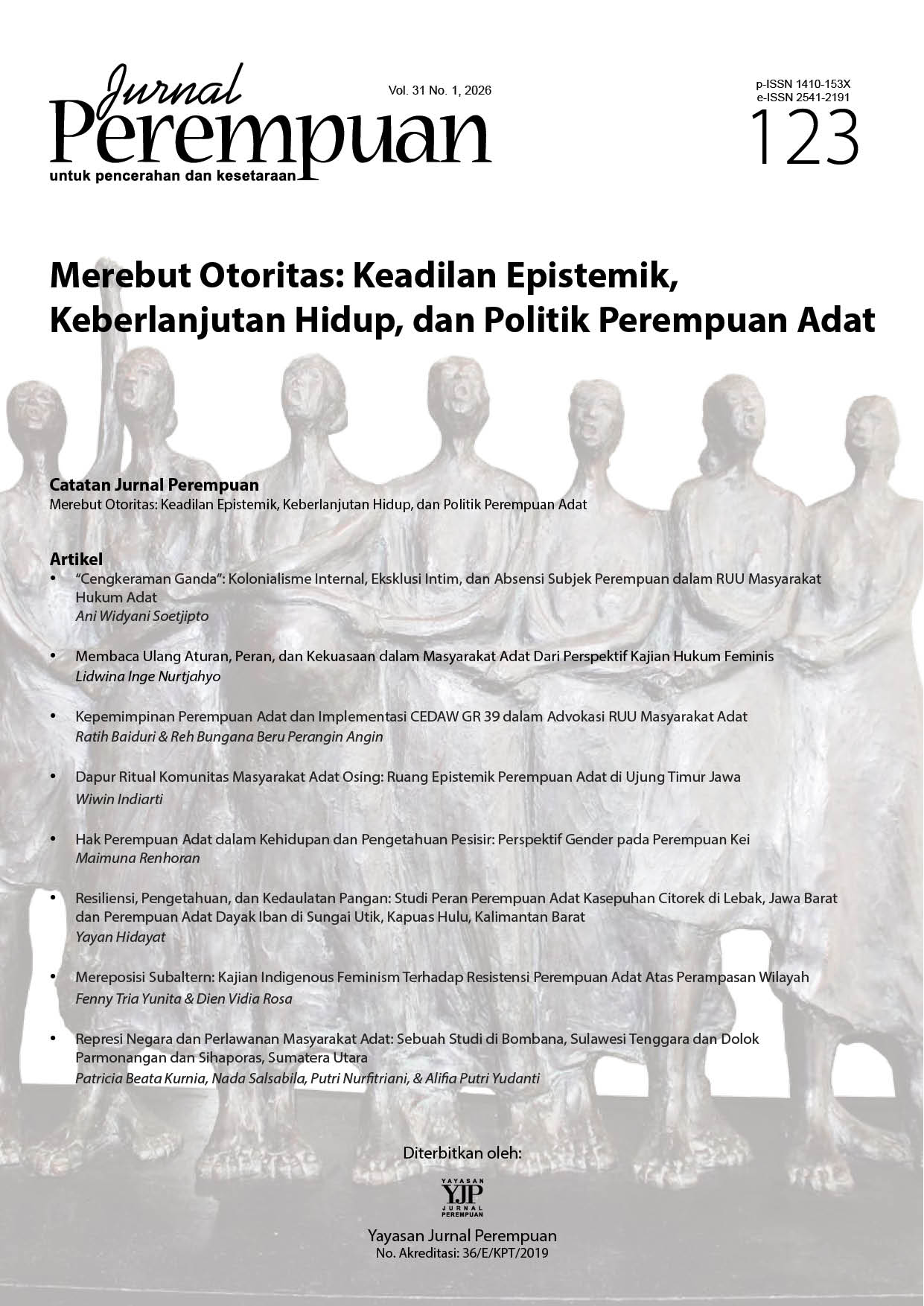
This study aims to analyze the role of Indigenous Women in strengthening the resilience of Indigenous Communities in Kasepuhan Citorek (Lebak) and Dayak Iban Menua Sungai Utik (Kapuas Hulu). This study uses a critical paradigm with a multiple case study approach and qualitative analysis, data collected through in-depth interviews, observations, and document studies for 7 (seven) months. Data were analyzed using the framework of rights to self-determination and indigenous feminism. The results of the study indicate that the recognition of indigenous territories, strengthening the rights of Indigenous Women, food sovereignty, and the implementation of self-determination are interrelated in building the sustainability and resilience of Indigenous Communities amidst the climate crisis and extractive development. Indigenous Women play a central role as guardians of ecological knowledge, managers of food reserves, and decision-makers in the customary system. These findings confirm that strengthening the rights of Indigenous Women is inseparable from the original rights of Indigenous Communities, and is the foundation of the ecological, social, and political sustainability of Indigenous Communities amidst the pressures of extractive development and the climate crisis. The existence of Indigenous Women is often invisible and unrecognized. However, as with indigenous feminism, gender justice is an inseparable part of recognizing the sovereignty and self-determination of Indigenous Peoples. This means that recognizing Indigenous Peoples is an integral part of recognizing the rights of Indigenous Women.
References
Information, F. S. (2025). Global Report on Food Crises (GRFC) 2025. New York: FSIN & GNAFC.
FAO. (2023). The status of women in agrifood systems. Roma: FAO.
Barume, A. K. (2025). Identification, demarcation, registration and titiling of Indigenous Peoples' lands: Practices and lessons. United Nations Special Rapporteur on the rights of Indigenous Peoples.
Pangan, B. K. (2022). Food Security and Vulnerability Atlas (FSVA). Badan Ketahanan Pangan.
Suganda. (2006). Kasepuhan Banten Kidul: Masyarakat Adat dan Pelestarian Tradisi. Kiblat Buku Utama.
Avé, J. B. (1986). People of the weeping forest: Tradition and change in Borneo. National Museum of Ethnology.
Eghenter, C. S. (2003). Social science research and conservation management in the interior of Borneo: Unravelling past and present interactions of people and forests. CIFOR.
Neuman. (2014). Social research methods: Qualitative and quantitative approaches (7th ed.). UK: Pearson Education Limited.
Mertens, D. M. (2009). Transformative research and evaluation. Guilford Press.
Creswell, J. W. (2018). Research design: Qualitative, quantitative, and mixed methods approaches (5th ed.). UK: Sage Publications.
Gerring, J. (2017). Case study research: Principles and practices (2nd ed.). Cambridge: Cambridge University Press.
Yin, R. K. (2014). Case study research: Design and methods (5th ed.). UK: Sage Publications.
Anaya, S. J. (2009). The right of Indigenous peoples to self-determination in the post-declaration era. Arizona Journal of International and Comparative Law, 26(2), 1-20.
BRWA. (2019). Profil Wilayah Adat Kasepuhan Citorek. Bogor: BRWA.
Hulu, P. K. (2018). Perda Nomor 13 Tahun 2018 tentang Pengakuan dan Perlindungan Masyarakat Adat di Kapuas Hulu. Kapuas Hulu: Pemerintah Kabupaten Kapuas Hulu.

This work is licensed under a Creative Commons Attribution-NonCommercial-NoDerivatives 4.0 International License.
Copyright (c) 2026 Jurnal Perempuan