
Keywords
dress code
hijab
five faces of oppression
lived body
How to Cite
Abstract
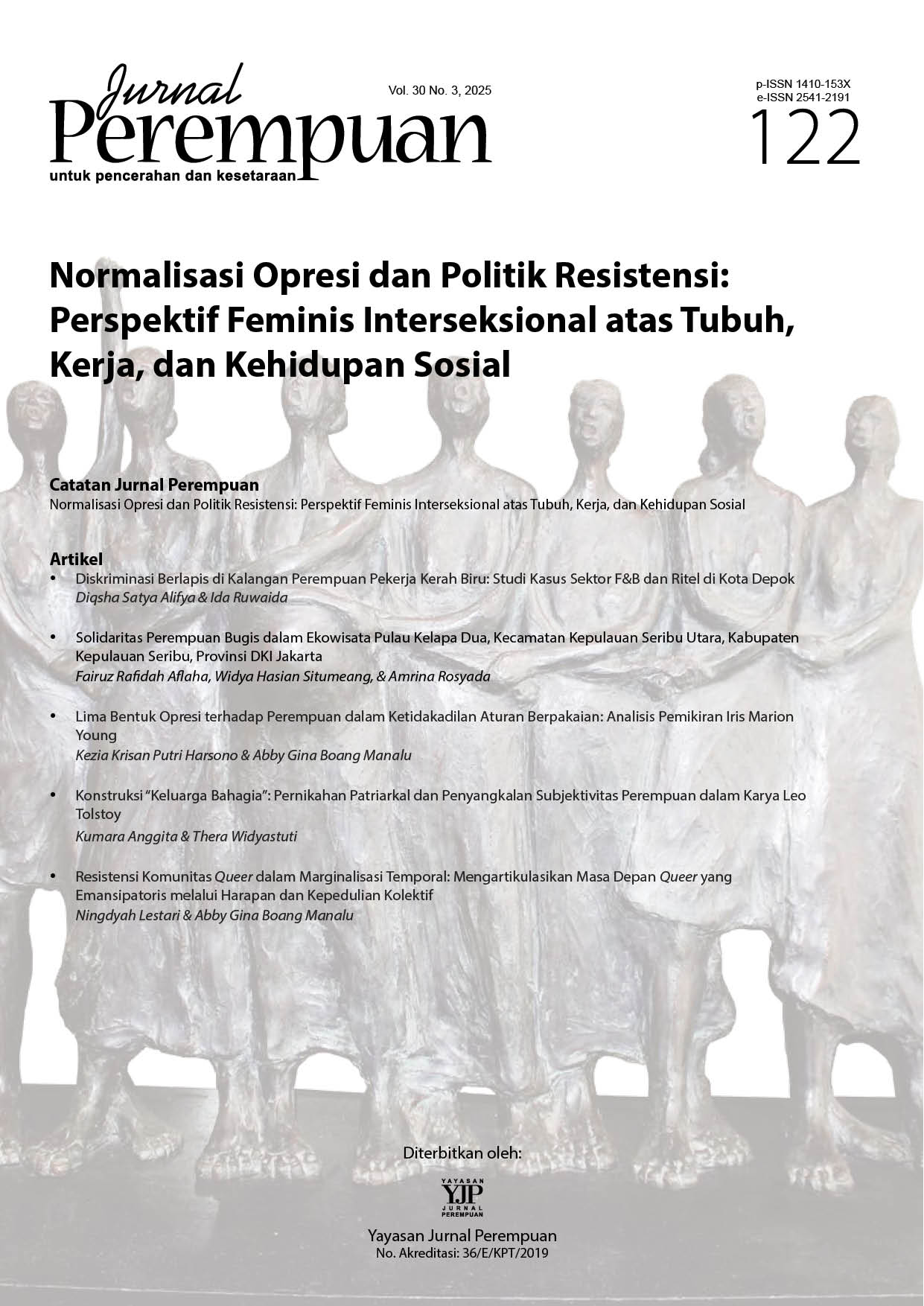
Based on women’s experiences documented in Human Rights Watch’s report “I Wanted to Run Away: Abusive Dress Codes for Womenand Girls in Indonesia” (2021), this article argues that the institutional imposition of the jilbab in Indonesia restricts women’s bodilyautonomy and produces structural harm. Drawing on a feminist perspective and Iris Marion Young’s framework of the five faces ofoppression, the study examines how dress-code regulations enacted by local governments and educational institutions operateas mechanisms of oppression. The analysis is limited to cases reported by Human Rights Watch and does not address the broadermeanings or practices of wearing the hijab. Methodologically, the article combines a literature review with feminist standpointepistemology and Young’s concept of seriality to read women’s narratives as situated knowledge of structural injustice. The findingsidentify four dominant forms of oppression in the documented cases: marginalization, powerlessness, cultural imperialism, andviolence.
References
Aini, N., & Siscawati, M. (2023). To Become Indonesian Women, You Have to Wear Jilbab.
Advances in Social Science, Education, and Humanities Research, 499–513.
https://doi.org/10.2991/978-2-38476-058-9_39
Allen, A. (2008). Power and the politics of difference: Oppression, empowerment, and transnational justice. Hypatia, 23(3), 156–172. https://doi.org/10.1111/j.1527-2001.2008.tb01210.x
Artaraz, B., Celaya, L., & Zuaitz, E. (2014). Dysmorphophobia: From neuroticism to psychoticism. Psychopathology in Women, 185–202. https://doi.org/10.1007/978-3-319-05870-2_9
Given, L. M. (2008). The Sage Encyclopedia of Qualitative Research Methods. Sage.
Human Rights Watch. (2021). “Aku Ingin Lari Jauh”: Ketidakadilan Aturan Berpakaian bagi Perempuan di Indonesia. Human Rights Watch.
Kementerian Pendidikan, Kebudayaan, Riset, dan Teknologi. (2022). Peraturan Menteri Pendidikan, Kebudayaan, Riset, dan Teknologi Nomor 2 Tahun 2022 tentang Petunjuk Teknis Pengelolaan Dana Bantuan Operasional Penyelenggaraan Pendidikan Anak Usia Dini, Bantuan Operasional Sekolah, dan Bantuan Operasional Penyelenggaraan Pendidikan Kesetaraan.
https://jdih.kemdikbud.go.id/detail_peraturan?main=3013
Laku, S. K. (2021). Ketika Demokrasi Membutuhkan Inklusi. Dekonstruksi, 4(01), 156–184.
https://doi.org/10.54154/dekonstruksi.v4i01.70
Laku, S. K. (2024). Tubuh dan Politik: Perspektif Feminis Iris Marion Young. Sapientia Humana: Jurnal Sosial Humaniora, 3(02), 125–138. https://doi.org/10.26593/jsh.v3i02.7324
Lutfi, A. P., & Wahyuningroem, S. L. (2023). Opresi dan Kuasa Atas Tubuh Perempuan dalam Tradisi Masyarakat Budaya: Studi Kasus Sunat Perempuan di Banten. Jurnal Perempuan, 28(1), 37–47. https://doi.org/10.34309/jp.v28i1.808
Boanganalu, A.G. (2021). Keadilan Sosial Feminis: Interupsi terhadap Universalisme, Abstraksi dan Imparsialitas. Jurnal Perempuan, 26(3), 159–172. https://doi.org/10.34309/jp.v26i3.628
Mason, E. (2022). Sexism, oppression, and misogyny. In Feminist Philosophy: An Introduction (pp. 123–137). Routledge.
Mulia, S. M. (2010). “Kata Pengantar Memahami Jilbab dalam Islam” dalam Juneman.
Psychology of Fashion: Fenomena Perempuan (Melepas) Jilbab. LKis Yogyakarta.
Pertiwi, S. (2022). Membaca persoalan hijab dan otonomi perempuan melalui epistemology ignorance. Paradigma: Jurnal Kajian Budaya, 12(2), 152. https://doi.org/10.17510/paradigma.v12i2.666
Phillips, K. A. (2009). Understanding Body Dysmorphic Disorder: An Essential Guide. Oxford University Press.
Pirmasari, D. A. (2020). To veil or not to veil? Islamic dress and control over women’s public appearance. Journal of Gender Studies, 30(2), 136–149. https://doi.org/10.1080/09589236.2020.1863199
Supma, D. C. (2019). Pendisiplinan Tubuh Perempuan Aceh Pasca Penerapan Syariat Islam Ditinjau dari Perspektif Feminisme Liberal. Skripsi Universitas Gadjah Mada.
Yolandasari, A. R. (2021). Against the Tarbiyah’s symbolism of hijab: Feminism, Islamic conservatism and reconstruction of hijab symbolism in Indonesia. Journal of Asian Social Science Research, 3(1), 15–38. https://doi.org/10.15575/jassr.v3i1.31
Young, I. M. (1990). Justice and the Politics of Difference. Princeton University Press.
Young, I. M. (1994). Gender as seriality: Thinking about women as a social collective. Signs: Journal of Women in Culture and Society, 19(3), 713–738. https://doi.org/10.1086/494918
Young, I. M. (2000). Inclusion and Democracy. Oxford University Press.
Young, I. M. (2005). On Female Body Experience: “Throwing Like a Girl” and Other Essays. Oxford University Press.
Young, I. M. (2008). Structural injustice and the politics of difference. In G. Craig, T. Burchardt, & D. Gordon (Eds.), Social Justice and Public Policy: Seeking Fairness in Diverse Societies (pp. 77–104). Bristol University Press.

This work is licensed under a Creative Commons Attribution-NonCommercial-NoDerivatives 4.0 International License.
Copyright (c) 2025 Jurnal Perempuan